
THE SMART BITE: ROOTED IN FAITH
Consider the Birds: A Simpler Way to Eat
I was reading Matthew 6 recently (cause I worry a lot). It’s the scripture where Jesus asks why we worry so much about what we’ll eat or what we’ll wear. Look at the birds, he says. They don’t plant or harvest, and yet they’re fed. Look at the flowers. They don’t labor or worry, and yet they’re cared for, dressed in more beauty than we could ever arrange for ourselves. It sounds so obvious when I read it. So simple. And still, I find a hundred things to worry about.
I believe food was always meant to be simple. We’re the ones who made it complicated.
I was in a friend’s kitchen recently, watching her cut up strawberries, and she started telling me how she learned about whole foods. Her son needed to lose weight, so she started reading labels. She realized the muffins they’d been eating every morning weren’t actually giving them what they needed. Such a small thing. But it was a reminder to me of the quiet power of whole foods.
Whole foods. What are they?
Here’s the simplest version. A whole food is a natural food, and especially an unprocessed one. A vegetable, a piece of fruit, a bean, a grain still in its whole form. Food that grows from the ground and shows up close to the way it started, not engineered. There isn’t even an official definition. It just means real food, with nothing added and nothing stripped away.
The opposite is the ultra-processed food. The muffin with an ingredient list as long as your arm, engineered to be hard to stop eating. I’ve actually given my husband permission to gently ask me, “do you want to keep eating that?” when he notices my hand’s been stuck in the chip bag too long. My answer is almost always yes!
So why does it matter? Because the science, and some of the biggest medical institutions in the world, have been pointing to this for a very long time. Harvard’s own nutrition experts point to a plate built mostly on vegetables, fruit, and whole grains. Eating this way is linked to a lower risk of chronic disease.
There is so much food noise out there, biohacks, new diets, but I love the simplicity of building meals around the whole food groups:
- Whole grains: the intact kind like brown rice, quinoa, oats, and 100% whole-wheat bread and whole-wheat pasta. They’re gentler on your blood sugar than white rice, white bread, and other refined grains.
- Fruits and vegetables: as much color and variety as you can manage.
- Healthy proteins: and here’s the part I love: Harvard lists the plant options first. Beans and peas, nuts, and seeds, then fish, eggs, and poultry. They also suggest limiting red meat like beef, pork, and lamb, and avoiding processed meats like bacon, deli meats, hot dogs, and sausage.
It’s back-to-school season, which is the perfect reminder that these same principles are exactly what’s recommended for our kids. Harvard even makes a kids’ version of the plate, linked below. Packing lunches and holding off the ultra-processed snack requests is the hard part, I know. (see Pigs Tips)
Life is already so full. Kids, work, the household. That’s exactly why I lean on whole foods to make mealtime easier. The birds aren’t counting anything. Neither are the flowers. And still, they are cared for.
This simpler way of eating doesn’t just take better care of our bodies. It cares for the earth God entrusted to us: the soil, the land, our water, the trees, and the animals. As usual, Jesus was on to something. And it leaves our hearts a simpler place to land, too.
Your Small Step
This week, start looking at your plate and thinking in whole food groups.
The ideal plate is half fruits and vegetables, a quarter whole grains, a quarter protein leaning toward plants. That’s the whole formula. No counting, no tracking, no app.
Notice how it feels to eat this way.
Do it once, and if it felt good, do it again tomorrow.
Pigs Tips
Two tools that make this easier in real life:
The Yuka app. We still eat boxed snacks sometimes, and when we do, this is how we choose them. Yuka lets you scan a barcode and see a clear score for what’s actually inside. It’s free, with extra features if you choose to donate. I hand my kids the phone and let them scan, and suddenly reading labels is something they want to do. It keeps me honest too.
Your whole foods grocery list. Half the battle is just having the right things in the house. We put together a simple grocery list of whole food staples, the grains, beans, produce, nuts, and seeds that make building these plates easy. Keep it on your phone, and the week gets a lot simpler. Download it here →
Go Deeper
A few things worth bookmarking:
-
- The Healthy Eating Plate from Harvard’s nutrition experts
- The Kid’s Healthy Eating Plate, the back-to-school version for our kids
- Easy Whole Plant Food Guide, my own simple guide to getting started
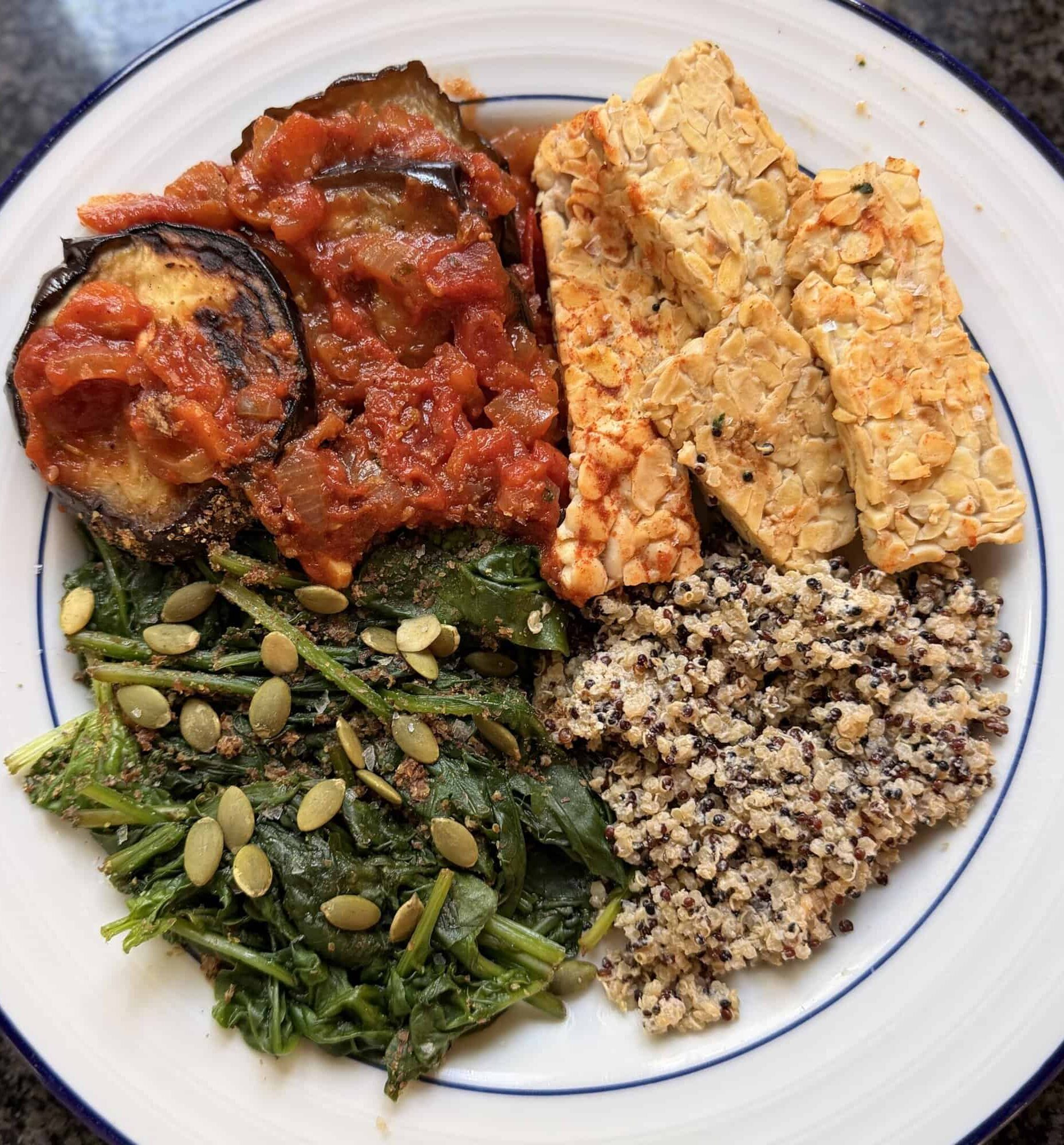
One Plate, Four Simple Parts
This isn’t so much a recipe as a picture of the formula. Half the plate is vegetables: sautéed greens with pumpkin seeds and roasted eggplant rounds with tomato sauce. A quarter is whole grains: tricolor quinoa. And a quarter is plant protein: seasoned tempeh. Swap in whatever you have on hand. That’s the whole point.
Pigs’ Scripture and Smiles
“Therefore I tell you, do not worry about your life, what you will eat or drink; or about your body, what you will wear. Is not life more than food, and the body more than clothes? Look at the birds of the air; they do not sow or reap or store away in barns, and yet your heavenly Father feeds them. Are you not much more valuable than they? Can any one of you by worrying add a single hour to your life?
And why do you worry about clothes? See how the flowers of the field grow. They do not labor or spin. Yet I tell you that not even Solomon in all his splendor was dressed like one of these. If that is how God clothes the grass of the field, which is here today and tomorrow is thrown into the fire, will he not much more clothe you, you of little faith? So do not worry, saying, ‘What shall we eat?’ or ‘What shall we drink?’ or ‘What shall we wear?’ For the pagans run after all these things, and your heavenly Father knows that you need them. But seek first his kingdom and his righteousness, and all these things will be given to you as well. Therefore do not worry about tomorrow, for tomorrow will worry about itself. Each day has enough trouble of its own.”
Matthew 6:25-34 (NIV)
Enjoyed this? Share it.


